The Accountability Stack
Map the accountability chain for any AI-assisted decision — and find where it breaks. In technology, a ‘stack’ is the set of layers a system runs on. Each layer depends on the one below it. If one layer fails, everything above it fails too.
Purpose
Map the accountability chain for any AI-assisted decision — and find where it breaks.
In technology, a ‘stack’ is the set of layers a system runs on. Each layer depends on the one below it. If one layer fails, everything above it fails too.
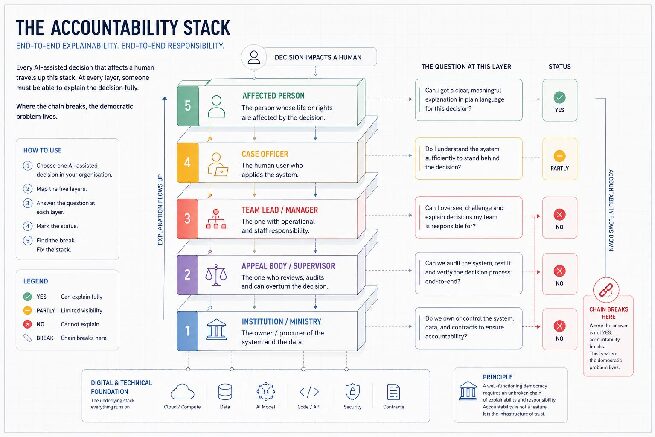
The Accountability Stack applies that same logic to democratic accountability. Take any AI-assisted decision that affects a person. Ask one question at each layer in the chain: can this layer fully explain the decision?
In a functioning democratic structure, the answer should be yes all the way down. In practice, it rarely is. That is the exercise.
Example
The Five Layers
L1 THE PERSON AFFECTED
Can explain: what decision was made about me, and why?
Receives a letter. Often no reasoning. Frequently no appeal path that works in practice.
L2 THE CASEWORKER
Can explain: why did the system flag or decide this case?
May know the output. Rarely knows the weighting. Follows the recommendation.
L3 THE SUPERVISOR
Can explain: what logic did the AI apply to reach this outcome?
Can review the caseworker’s judgement. Cannot access the model’s decision logic.
⚠ THE ACCOUNTABILITY GAP — Below this line, no one can explain the AI’s decision logic.
L4 THE APPEALS BODY
Can explain: whether the AI’s decision was correct and auditable?
Supposed to provide independent oversight. Cannot audit what it cannot access.
L5 THE INSTITUTION / MINISTRY
Can explain: what the model is actually doing with citizens’ data?
Procured the system. Often does not own the model. Contracts may prohibit full disclosure.
KEY INSIGHT
Where the stack breaks is where the democratic problem lives. It is not a bug. It is a construction.