Challenge The Bot
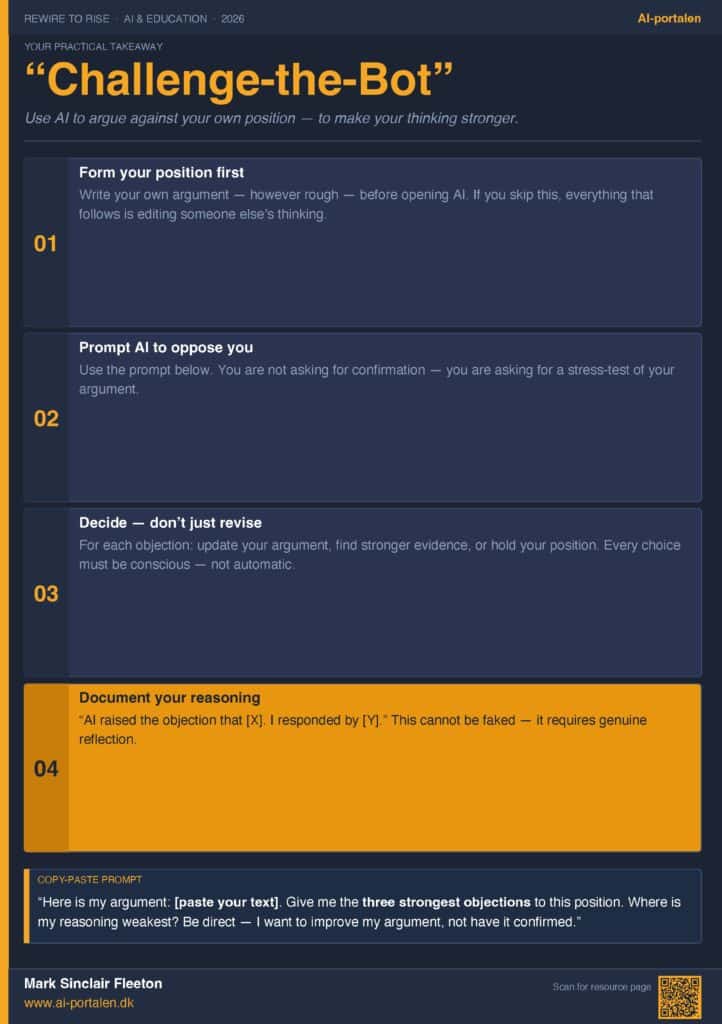
Use AI to argue against your own position — and make your thinking stronger. Most people use AI to get answers. This exercise turns that around: you use AI to attack your own argument before anyone else does. The goal is not to change your mind. The goal is to find out how strong your position actually is — and to own every conclusion you put your name to.
Purpose
Why This Matters Beyond the Exercise
The Challenge-the-Bot method is not a critique of AI. It is a critique of a particular pattern of AI use — the pattern that treats AI as a source of answers rather than a tool for examining questions.
That distinction matters more in some contexts than others. For routine tasks, it probably does not matter much. For decisions where you will be held accountable — where you will be asked to explain your reasoning, defend your position, or make a judgment call under pressure — it matters a great deal.
The question cognitive science raises about AI-assisted thinking is not whether the output is accurate. It is whether the person behind the output has built the judgment to evaluate it. A generation that can produce polished arguments but cannot defend them is not a generation that has developed critical thinking. It is a generation that has learned to simulate it.
Challenge-the-Bot is one small, practical intervention against that trajectory. It does not require you to distrust AI. It requires you to use it at the right moment in the process — after you have thought, not instead of thinking.
The point is not to let AI win the argument. The point is to find out where you would lose it — before someone else finds out for you.
Example
To run the exercise, use this prompt after writing your own argument:
COPY THIS PROMPT
“Here is my argument: [paste your text]. Give me the three strongest objections to this position. Where is my reasoning weakest? Be direct — I want to improve my argument, not have it confirmed.”
The phrasing of the final sentence matters. AI systems tend to be responsive to the framing of requests. Asking for confirmation produces confirmation. Asking for challenge produces challenge.